
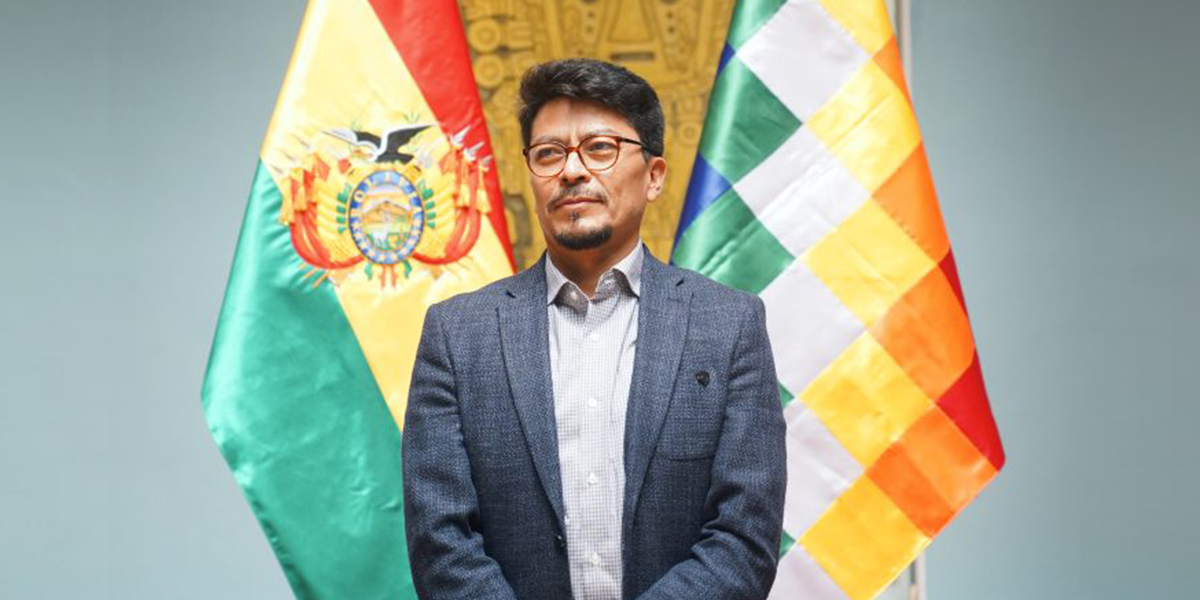
09 Jul Interview with Fernando Amaraya, Ministry of Foreign Affairs Bolivia
What is the vision behind this new perspective that Bolivia is reopening to the world?
It responds to a new understanding of what the world is facing in terms of the reconfiguration of globalization, geopolitics and geoeconomics. These are times in which, on the one hand, foreign policy operates under constant unpredictability. On the other hand, we recognize that we are entering a new era in which multilateralism needs to be updated. Post-war multilateralism is very different from multilateralism in the midst of war. When I say this, people often mention Ukraine, but I’m referring to technological war and trade war. In other words, we are living in a time of war through other means, which has also led to the formation of new blocs. These blocs are often simplistically described as the Chinese bloc and the American bloc, but the reality is far more complex.
States are no longer the sole actors defining the course of geopolitics. The growing influence of tech companies — which do not necessarily have a society behind them or regulatory frameworks like constitutions — has reshaped the geopolitical landscape. This also brings uncertainty, as we are living in the age of artificial intelligence, general AI and even superintelligence. Some theorists suggest that, in a broader view of the future, human beings may become just one part of a story whose outcome we still do not understand. These are just a few brushstrokes of this new global reordering.
At the same time, the mining sector in countries like Bolivia, Argentina, Peru and Chile has been reactivated due to a global push toward energy diversification. We do not speak of an energy transition, but rather energy diversification, because it is unlikely that fossil fuels will be abandoned entirely; instead, additional energy sources will be incorporated. This, combined with increased defense spending in several countries, is creating new pressures that add to technological, climate and social pressures — particularly those linked to polarization. All of this places additional pressure on mining activity and, consequently, on environmental considerations from another perspective.
If we place this in context and then look at Bolivia, we see that for 20 years the country operated from an ideological trench without substance — one that conveniently isolated Bolivia from global scrutiny. This isolation reduced accountability and the demand for transparency. The country was effectively isolated to build a narco-state. There is no doubt about that. What followed is what I call “criminalized governance” — not governability, but a system involving actors both inside and outside the state, shaped by organized crime, drug trafficking and illicit economies. These dynamics penetrated not only government institutions but also social structures and the private sector.
As a result, 20 years of isolation turned Bolivia into what we call a “bottleneck country” — unreliable and to be avoided. When looking at infrastructure projects such as bioceanic corridors, investors have chosen to spend hundreds of millions — even billions — just to bypass Bolivia, a country that by its very nature should serve as a key connectivity hub for the continent.
How do you see Bolivia’s place in the region and in the Americas given the changing geopolitical landscape and erosion of rules-based order?
You cannot think of a defense shield for the Americas without including a country that shares five borders. Nor can you think about logistics connectivity or improving supply chains without placing at the center a country that can connect Brazil — the giant of the Latin American economy — with Chile. Bolivia also holds one of the largest concentrations of critical minerals and rare earths, which are essential to this energy diversification.
We are a living example that it is possible to dismantle a narco-state through democratic means. We are the first to do so, relying on the will of the people. This transformation process is complex — many countries can dismantle a regime, but what happens the day after is what truly matters and there are many global examples of that. We are currently in a transition process that this government has chosen to turn into a transformation. That is why we have approached it with the intention of breaking paradigms and stereotypes in the exercise of political power and governance.
Who would want to stay in a country disconnected from the world? Who would want to invest in a country with no security or certainty, operating under coercion, transactional relationships and the rules of organized crime? This was a country everyone wanted to leave — young people, professionals, investors. Our vision is to turn it into a country everyone wants to come to. We believe Bolivia can become an attractive place to invest, to bring your savings and even to retire. We have extraordinary geographic and landscape diversity. We have energy stability, which is extremely valuable in today’s context. We also have social peace. This leads us to believe that, within five years, Bolivia can become a country where retirees want to live, where foreign companies want to invest, where professionals want to work and where international students want to study.
Our vision is simple: we want Bolivia to be rediscovered. “Bolivia for the world and the world in Bolivia” means reclaiming the possibility of becoming what we were always meant to be — recovering our future. Isolationism took that future away from us.
We all have history — especially in relation to Chile, Peru and Brazil — but we also have the right to build a future. That is our vision: a Bolivia ready to be discovered by everyone, across all sectors — investment, education, technology and tourism. We aim to achieve this transformation within five years. We do not believe in a passive transition or administration which is why we have made difficult, complex and risky decisions from day one.
What are the concrete steps or measures that will make this vision a reality?
First, consolidating political stability. These are not sequential steps — I am not outlining a prediction, but rather key dimensions. We have emerged from a scenario in which there were very low expectations regarding how smoothly the 2025 electoral process would unfold. All the warning signs have been deactivated and a two-round election has been achieved, which helps diversify risk. The risk from the first round does not disappear in the second, but this process has allowed us to consolidate the beginning of a reconfiguration of the country’s democracy.
Second, economic stability. Within this dimension, the monetary and financial programs are fundamental. However, we have also come to understand that both macro and micro levels matter — but we are living in times of affective, emotional polarization, largely amplified by social media. Today, the way people consume political, social and media content has changed. In the past, people had clearer ideological frameworks and could distinguish between left and right, or between what was democratic and what was not. That clarity has faded. The exchange of rights for certain benefits or outcomes of public policy has blurred these lines significantly.
This is not a minor issue, because economic stability is not only about Moody’s ratings, country risk, or net international reserves — though all of these are crucial. It is also about how society perceives your ability to provide certainty and build trust through firm decisions and a sense of predictability.
In economics, we refer to this as adaptive and rational expectations. When a government fulfills its promises from day zero, people recognize it. When we announced an economic stabilization program with serious measures, we were not only addressing our citizens, we were also signaling to other countries, multilateral banks and international organizations. Typically, they would say: “Let’s wait six months or a year, 120 days is nothing,” yet, in less than three months, we made decisions not seen since the 1970s, such as removing fuel subsidies. This was done under a dual logic: not only to safeguard macroeconomic balance and address the shortage of dollars, but also to discourage smuggling and the illegal or gray economy linked to fuel.
Our challenge, unlike traditional approaches, has not been limited to macro and microeconomics, but has also included dismantling the illicit economic structures built around sectors such as hydrocarbons. This is why, when subsidies were removed and prices were adjusted, demand dropped by 50% almost immediately. This revealed that much of the demand was not genuine — it was driven by smuggling and cross-border arbitrage due to lower domestic prices. Economic stabilization has therefore been a core pillar from day one.
The third element is governance and governability — political and social stability. Bolivia is often described as an over-organized country. For example, in El Alto, the same individual may simultaneously be a neighborhood leader, a transport union leader, a representative of a trade group and even linked to a political organization. That is our reality and it requires us to understand governance from a different perspective. When we implemented the economic stabilization decree — only the first stage, with others to follow, such as exchange rate unification and tax incentives for investment — we knew the process was far from complete. Like in foreign policy, there are multiple phases ahead.
At that moment, we had two options: the traditional one — deploy police and military force to impose the decision — or pursue dialogue. Even though more than 80% of the population supported the measure and only about five percent opposed it, that minority had strong mobilization capacity. The majority does not take to the streets — but the minority does. As the philosopher Zabaleta described, these are “effective minorities” — groups capable of driving change through mobilization and agenda-setting.
So we asked ourselves: repression or negotiation? The president made it clear — we would not change the country’s logic; we would exhaust all avenues of dialogue and negotiation. We endured a siege of 7,000 mobilized individuals, some even entering offices in disguise. We did not back down — we governed from our offices. This was true for the president, for this foreign ministry and for the minister of the presidency. We negotiated, reached agreements and continued governing.
This socio-political stability is not guaranteed — none of these three dimensions are. We must continue working, because we are trying to transform a 20-year reality. Managing a government is not the same as dismantling a long-standing regime. We are coming out of a regime and that is something people do not always fully grasp. Transforming a 20-year regime within five years of government — especially one embedded in a broader regional dynamic — requires decisions of this magnitude. That is why, when we were asked to evaluate the first 120 days, my response was simple: we did not have 120 days. The romance was brief, the honeymoon barely existed. We went straight into the marriage.
Bolivia borders five countries and is a key part of South America and it is already part of the global economy. With that in mind, what are Bolivia’s priorities? Should it focus on South America, or look outward to North America, Asia, or the whole world?
Our perspective is global. We do not see ourselves as a country that must move sequentially — first working with neighbors, then the continent and only later other regions. Rather, we have experienced what could be called a “clover effect,” in the sense that we have been historically postponed — we are an underinvested country.
That is a term you do not often hear today, because in many places the issue is the opposite: an excess of investment and debates about how to regulate or even limit it, along with renewed discussions about more market versus more state. In our case, however, we are underinvested. Net foreign direct investment — meaning inflows minus outflows such as profit repatriation — likely did not exceed $500 million last year. That is negligible within global capital flows.
Second, we have been significantly lagging in technological innovation. Third, we failed to take advantage of our resources at a time when global dynamics generated major benefits for countries like Peru and Chile. Peru generates around $50 billion annually from mining; Chile, around $60 billion. Chile, with far smaller lithium reserves than ours, ranks among the top three global producers. Meanwhile, Peru, Chile and Brazil manage between $11 and $15 billion in environmental finance, while we remain at zero in that area. We export about $6 billion in minerals, despite being the country with the greatest overall mineral wealth: 32 of the 35 critical minerals listed by the United States are found in Bolivia.
All of this may seem negative, but from a future-oriented perspective, it is actually an advantage. Because we have not been tied to past waves of technological innovation, we are not burdened by outdated technologies that others now struggle to replace. We can leap directly into new technological paradigms and, if we act intelligently and build the right partnerships, accelerate our learning curve.
However, this requires a redefinition of foreign policy and international relations. If we can provide legal certainty, economic predictability and social peace, we will once again become attractive for foreign direct investment. Unlike many countries, our resources remain largely untapped: lithium, gold, beryllium, cadmium, niobium, indium — we hold the world’s largest indium reserves. These are key minerals for what is often called the energy transition, though we prefer to speak of energy diversification. In this sense, our condition of underinvestment becomes an advantage: it opens the door to a phase of super investment.
Another key factor is our geographic position. We are at the center of a continent that could be a major global player in the next century. In terms of water resources, 60% of the water that feeds the Amazon originates in Bolivia. Around 32% of global biodiversity is concentrated here. We have the potential to connect the north and south of the continent, with only short missing segments — less than 200 miles in some areas. We can reactivate ports and economic corridors in Chile, particularly in Atacama, and connect Chile with Brazil. We could even develop logistics routes from Santa Cruz to the Dominican Republic and from there reach Asia within 24 hours.
This potential for relevance means our foreign policy must go beyond political positioning — it must have a strong commercial DNA. The role of this ministry is to attract investment; once it reaches the country, other ministries will channel it internally. Therefore, Bolivian foreign policy must energize foreign trade, attract technological innovation and build agreements that restore our geopolitical role as a hub of connectivity. Even with relatively modest investment, we could develop energy infrastructure linking Brazil’s surplus to Chile’s deficits through Bolivia. We can also position ourselves in data flows: today, everything runs on data and our geographic location allows us to play a strategic role in digital services and connectivity. This is the essence of a modern foreign policy with new priorities.
At the same time, we do not overlook the political dimension. We have positioned ourselves in defense of democracy and human rights. We will not support actions against civilian populations or violations of rights. As the president has said, we stand with democracy, not with dictatorships, whether from the right or the left.
Finally, this is why we have not yet completed the structure of our foreign service. I am asked every day: ‘When will ambassadors be appointed?’ The answer is clear: first we must define what we want from our foreign policy and international relations; only then can we determine the appropriate profiles. We need expertise in geoeconomics and geopolitics, clear metrics and KPIs to measure results. In some cases, chargé d’affaires may even play a more prominent role than ambassadors. This is the architecture of our foreign policy: to take Bolivia to the world and bring the world to Bolivia.
What would be the message you would send to investors, to readers from the United States government and at a global level?
Underinvestment, vast mineral and natural wealth and strong tourism potential. In other words, we are a country that can offer a great deal to those willing to come and invest here. We are currently defining our business model and we can co-build that model together with the investors who come to Bolivia.
What can they expect? There will be new rules and a new phase moving forward. This is the moment, because the business model is still under construction. You can either come in and adopt a model imposed by the state, or be part of building it. Those who come first and form partnerships with us will co-create this model and this path forward — a path that has already shown clear results.
We said we would ensure fuel supply — check. We said we would control prices — check. We said we would send signals to the world — and we have: we removed tourist visa requirements for those we want as partners — check. You will soon see the next measure regarding visas. We have begun renegotiating our diplomatic relations. We have taken direct action against organized crime. We captured one of the three most wanted individuals by the DEA worldwide without firing a single shot — extremely fast and highly efficient.
Sorry, the comment form is closed at this time.