
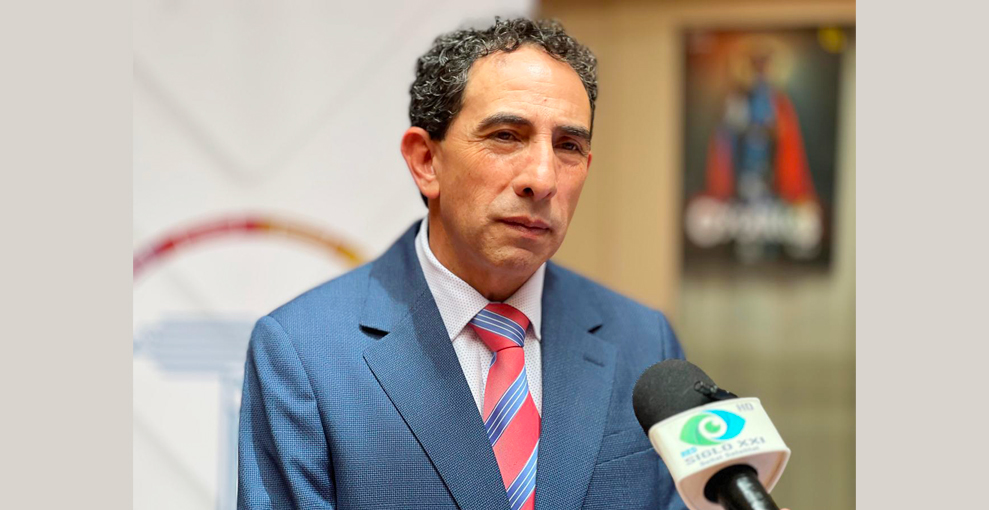
20 May Interview with Christian Eduardo Rojas, Executive Manager of Mi Teleférico
Mi Teleférico has become one of the most recognized urban infrastructure projects in Latin America. What do you consider has been the greatest economic and social impact of the system since its inauguration?
Approximately one month ago, we reached 700 million transported users, or basically 700 million lives transported through Mi Teleférico. So, in 12 years, we have had the capacity to move an average of slightly less than 80 million people per year. Of course, this has significantly changed the dynamics of urban and metropolitan mobility, specifically in the city of La Paz. The economic impact, beyond the very high investment in the infrastructure operated by the cable car system, has directly benefited the population. Mainly, our users are segmented into approximately 35% pupils and students, while the remaining 65% corresponds to people who use the system for work-related needs or to carry out errands and administrative procedures. Therefore, the impact that Mi Teleférico has had on the city of La Paz and between the cities of La Paz and El Alto, or El Alto and La Paz, has been very significant.
As in any state that is still highly centralized, virtually any procedure you need to carry out basically requires coming to the government city in order to complete it — that is, coming to La Paz. Of course, not in every case, but previously this was much more pronounced. Now, naturally, there has been a certain degree of decentralization. And that is precisely the objective: to build a more efficient state, a state that is not an obstacle or a barrier, but rather a state that serves the population. These offices are the first step in this effort to establish a presence in the city of El Alto, because they are two very large cities that are contiguous, essentially connected.
The idea is to offer people the possibility of not having to necessarily travel down to the city center, spend two hours commuting to reach an office, but instead be able to access certain services initially within their own city, such as telephone services, postal services, or inquiries with other institutions. That is what this new office represents for the city of El Alto and we consider it to be a major step forward, even if it is still a small one. It demonstrates, as a state and as a government, what is intended to be implemented in the country, in this new Bolivia that is being promoted. We are moving away from a path that sought to orient itself toward socialism and trying to redirect the course toward a center, probably with much more capitalist-oriented policies.
La Paz and El Alto present enormous geographical and urban mobility challenges. How has the dynamic of transportation and connectivity between both cities changed thanks to the cable car system?
It has changed in a very important and impactful way, not only in terms of mobility, but also in the area of women’s empowerment and violence against women. Mi Teleférico is mainly preferred by women, boys and girls. The highest percentage of our transported users are usually women or children because they find that we not only provide transportation services with punctuality and safety, but they also perceive it as a place of security.
Beyond that, among these 700 million passengers we have transported, we can say that every day we impact approximately 10% to 12% of the total mobility of the entire cities of La Paz and El Alto. We currently average 275,000 lives transported per day and to date, despite the difficulties and problems that this may currently imply, the ticket fare has not increased.
In recent years there has been strong underinvestment in operations and maintenance. What we call a ‘technical debt’ has been created,and this is something we are trying to reverse in light of the fact that ticket prices have remained unchanged over the past 12 years.
We are currently working together with all levels of government to reverse this situation and, internally as a company, we are focusing mainly on the business area to improve our business portfolio and advertising portfolio and to find better revenue conditions for Mi Teleférico. In this way, we are trying to avoid becoming dependent on subsidies. Mi Teleférico, to date, is not a State-subsidized service; it sustains itself with its own resources. The challenge ahead of us is growth, in order to improve our revenues, which are mainly reinvested into maintenance and operations.
Will increased revenues also help in the future to expand the system with more lines and improve the existing ones?
As Mi Teleférico, we are trying to be as autonomous as possible from the central government. We are carrying out negotiations with both national banks and international financing organizations in order to secure loans that will allow us to expand with additional lines.
At the moment, we operate a system consisting of 10 lines and 21 miles of coverage; in other words, our operation encompasses 21 miles of cable transportation. To date, it still remains one of the largest urban cable transportation systems in the world. Soon Mexico will probably take away the Guinness record that we currently hold, but nevertheless, we continue to be a massive transportation system operating 16 hours a day.
However, we actually work 24/7. That is, we provide passenger service for 16 hours, but maintenance operations run 24 hours a day, seven days a week. Therefore, we need to secure financing — and we have already basically identified the full service demand, which we are currently meeting at around 90% — through these loans in order to expand and further develop our entire line expansion program. With the vision of “Bolivia in the world and the world in Bolivia,” we are working on implementing a transformation: moving from being a cable transportation company to becoming a public transportation company that, as a state-owned enterprise, provides transportation services throughout Bolivia in a broader sense.
These services do not necessarily have to be cable cars; they could include trains or buses as well. This is the vision that the company wants to pursue in order to consolidate itself as an operator that, in the future — because this is obviously a very large-scale project — could probably provide public transportation services under the same standards and characteristics with which transportation systems around the world normally operate, led or managed through governments.
Is Mi Teleférico currently interested in potential apps and technological investments or know-how from the United States?
Yes, absolutely, of course. The concept of transforming from a cable transportation company into a public transportation company comes precisely with that requirement. It would probably be too large of an investment for the central government alone to consolidate a nationwide public transportation company. Therefore, we do need the support and contribution of foreign investors who may be interested in the various forms of partnership that could be established. Obviously, a public-private partnership is the direction being promoted by the Minister of Public Works, Mauricio Zamora, who is working intensively on finalizing the regulations and legal framework regarding how we will provide legal certainty, what tax incentives will be offered to foreign investment and how we can guarantee those investments in the long term.
I believe those three components are the most important elements that this public-private partnership law must include. Through that mechanism, Bolivia is eagerly awaiting investment from countries both near and far in order to help develop a national vision that, above all, benefits the population.
Environmental sustainability has become a priority for modern cities. What importance do renewable energy projects have within Mi Teleférico’s future strategy?
Well, they are extremely important. We are looking toward change starting from the fact that we are a transportation system that does not generate carbon emissions. We operate primarily with electric energy, meaning that our impact in terms of transportation is not as high.
However, during this 2026 administration, we are aiming — and I hope we can achieve it this year — to install solar panels on all the roofs of our stations, together with battery storage systems for energy accumulation. The idea is to reduce our impact and, above all, lower our carbon footprint. Even though we do not produce carbon emissions as such, this project would continue contributing significantly in that direction.
Currently, Mi Teleférico already contributes approximately 40% toward these types of initiatives and we hope that the solar panel and battery project can be implemented within the next 12 months, substantially changing the energy injection structure at our 10 stations in the city of La Paz.
Additionally, the transformation project toward becoming a public transportation company is also closely linked to incorporating options such as electric buses and other cable-based mobility systems that are not necessarily suspended cabins. There are also trains and other cable-operated systems that likewise aim to generate the least possible environmental impact.
Mi Teleférico has also become an international tourist attraction. How can the system contribute even further to Bolivia’s economic and tourism development?
Mi Teleférico is a landmark in Bolivia and everyone who comes as a tourist and has the opportunity to visit the city of La Paz definitely feels compelled to experience at least some — if not all — of the routes offered by Mi Teleférico. Due to the topographical characteristics of La Paz, it is not only a transportation experience, but also a very intense visual experience, because you have snow-capped mountains, ravines, mountain ranges, the valley of La Paz and the plains of the Altiplano. It is a very important mix and a very interesting adventure for tourists. Mi Teleférico handles approximately 45,000 identified tourists per month. In other words, we do not have completely exact data, but we do keep track of people whom we can identify as foreigners or tourists.
We are currently working on two concepts and we hope they will be launched soon. Mi Teleférico is finalizing the release of a mobile phone application designed to help people enjoy Carnival festivities. Carnival here is a very special occasion and we have one of the most important carnivals in the world: the Oruro Carnival, which is normally celebrated between February 10 and the first week of March, depending on the religious calendar, since it is mainly linked to Ash Wednesday, when Lent begins leading into Holy Week.
The Oruro Carnival is recognized by UNESCO as an Intangible Cultural Heritage of Humanity and is one of the most important carnivals in the world. We expect to receive approximately half a million people during Carnival and even ambassadors, such as the ambassadors of Switzerland and Sweden, participate in the activities associated with our Carnival.
Mi Teleférico also has a significant technological development department, which enables us to create applications that provide instructions, recommendations and points of interest and which can also function without mobile data — something extremely important during massive gatherings of people where internet connectivity often becomes slow.
But most importantly, Mi Teleférico is working to consolidate itself as the gateway to tourism in Bolivia. We are preparing an entire promotional campaign that will showcase Bolivia through one of its main urban attractions, which is Mi Teleférico.
Soon, we will launch a social media campaign where you basically open the cabin door and suddenly appear in Santa Cruz, or open it and appear in Oruro during Carnival. The idea is to use Mi Teleférico as a platform to promote tourism in Bolivia, not only as a transportation service, but also by showcasing the country’s beautiful tourist destinations. Although Bolivia is considered a third-world country, Mi Teleférico can be an exception, offering a first-world service thanks to its cleanliness, punctuality and safety.
Bolivia mainly needs to capitalize on its natural and native attractions. We have high mountains, but also the Amazon region, where wildlife is immensely rich and still largely untouched. Everything related to sustainable tourism in Bolivia is completely natural, because we still have that possibility thanks to the fact that we have not developed our industries and lands in such an intensive way. Because of that, we can still fully enjoy nature.
What would be your final message to the readers of this very important USA Today report about Bolivia, considering that you are a civil engineer and that you seek to promote institutional transparency, modern energy sustainability and technological modernization?
I believe that we are trying to build, through the guidelines established by President Rodrigo Paz, a Bolivia that is open to the world, as he himself has clearly expressed. Significant conditions are being created to make investment in Bolivia possible, basically across all sectors. We have not been particularly successful in the past in taking advantage of our possibilities and resources as a country and of course during the last 20 years we have also experienced a slowdown, with a vision or direction oriented toward a different economic system. Therefore, the possibilities remain endless for developing tourism, transportation, mining and business in general.
I encourage all the people who will read this report to turn their attention toward Bolivia. Work is being done to provide certainty, legal security and tax conditions aimed precisely at attracting what this country needs.
Bolivia is an immense country with a population density of nearly two people per square kilometer. So, you can understand that we must work on many issues as a country in order to regulate development, because we do not intend for this to become an environmental, social, or any other kind of disaster. Yes, we need to work on many regulations, but we believe that this is a very important opportunity for our country to open itself to the world and, above all, to provide a future perspective for our grandchildren — not even for our children, because our children are already here with us. But perhaps our grandchildren may enjoy a better country, with better quality education and better healthcare for the population in general. That would be my message: we are waiting for you, there are very good opportunities and the conditions are being created for those investments to land in Bolivia.
Sorry, the comment form is closed at this time.