
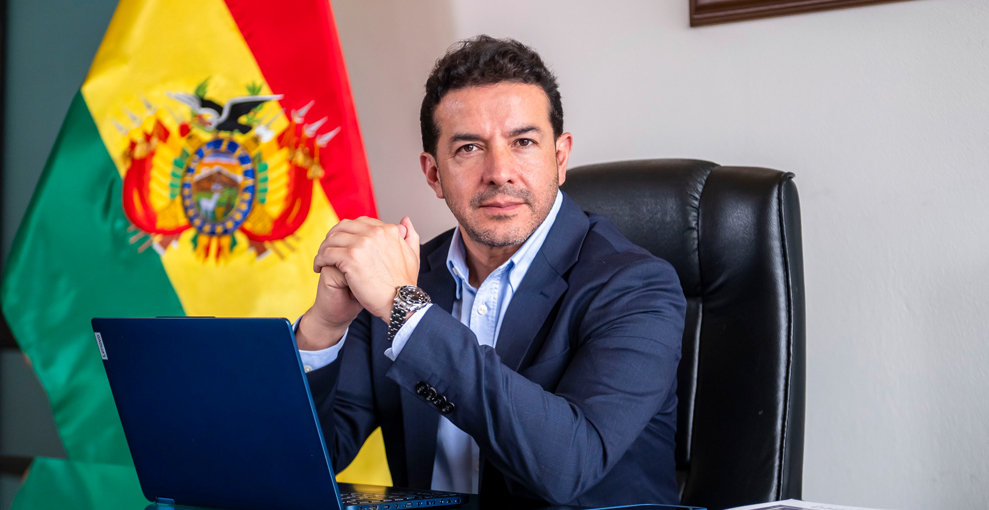
06 Jul Interview with Ernesto Farfán, Executive Director of the Bolivian Highway Administration (ABC)
Bolivia faces significant geographic and logistical challenges in developing its road infrastructure. What do you consider to be the country’s main challenge today in modernizing and maintaining its highway network?
We have a very complex geography. We are a vast country of more than 386,000 square miles and within that area, we have every type of climate: mountains, plains and areas where it rains almost all year round. Therefore, it is a challenging geography for the Fundamental Road Network, which is the highway system administered by the ABC.
At the same time, we have gone through many years in which road maintenance was neglected. On the other hand, the road network has expanded from approximately 7,500 miles five years ago to nearly 12,500 miles today. However, this expansion of the Fundamental Road Network has not been accompanied by an increase in budget allocations. Therefore, the challenge we face today is managing the necessary resources, through different funding sources, to strengthen road maintenance and preservation. Bolivia focused heavily on construction at one point, but maintenance was neglected. That is why our challenge is to transform the maintenance system and design a National Road Maintenance Fund capable of responding, above all, to emergencies. The geography, combined with climate change, has caused rainfall, landslides and collapses to become increasingly frequent and this trend will continue. Therefore, we need a mechanism that allows us to respond to emergencies at recurring critical points throughout the country. At the same time, we need new regulations that allow us to be more efficient in addressing these types of events. That is the main challenge in terms of maintenance and preservation.
In terms of constructing new highways, the challenge is to complete a series of bi-oceanic corridors that we have planned throughout the country. Bolivia has a highly strategic geographic location, but this location is not an advantage today if the highways are not fully developed.
In order to truly gain a competitive advantage and use our geographic location as such, we must become a transit country rather than a “country of roadblocks,” as the president says. That is why we must complete these corridors. We have several corridors in the northern part of the country, east-west corridors and other strategic projects. In addition, there is a major grain cargo hub in Mato Grosso do Sul, Mato Grosso and the state of Acre in Brazil that needs access to the Pacific Ocean. Currently, shipments bypass Bolivia by going around the north, but at much higher logistical costs. We can become strategic partners for Brazil to the extent that our highways and corridors allow this transit. If you look at the map, there are already consolidated corridors in use today, but several sections still need to be completed. A corridor only works if all of its links function properly; if one section is in poor condition or remains in a constant state of emergency, then the entire corridor stops functioning effectively. That is why we need this infrastructure and that is the challenge we face in terms of construction.
There are several allied partners and financing institutions supporting us, such as multilateral organizations including CAF, the World Bank, the IDB, Fonplata, Korea Eximbank and others. Nearly 90% of our construction projects are financed by these organizations. Together with them, we share the challenge of completing these corridors so that Bolivia can become an efficient transit country and a strategic ally to its neighboring nations in terms of infrastructure and logistics. Those are the two most important challenges we face over the coming years.
In order for Bolivia to become a regional logistics hub thanks to its strategic location, how open are you to potential public-private partnerships (PPPs), especially from the United States?
Yes, I believe that is another major challenge in terms of regulatory design. PPPs make several things possible, among them is the mobilization of private resources, which is exactly what Bolivia needs today. Bolivia needs to partner with the private sector. There is now a vision of seeing companies and private investment as a fundamental complement to road infrastructure development. In addition, PPPs help make processes more transparent; they are an advantage. The world is moving in that direction and Bolivia needs to take that step as well.
I believe this had not happened before because there was a different perspective. Today, however, we see companies and private investment as fundamental and absolutely necessary actors. That is why work is currently being carried out — led by the Ministries of Planning, Public Works and Economy — to develop regulations that will allow this step to happen. This also involves guaranteeing legal certainty, because the foundation of PPPs is having a regulatory framework that protects private investment. The president has set a very clear direction in this regard. Perhaps recent history did not support these kinds of signals, but now we must create a regulatory framework that provides full legal certainty in order to move forward with PPPs.
So yes, we are completely open to it. We have discussed this extensively with our financing partners: we need to take this step. Obviously, highways are one of the infrastructure sectors with the greatest potential for PPP development in Bolivia, especially in the corridors that will experience high cargo traffic. In this way, investors will be able to recover their investments within a clear regulatory framework while also leaving the country with infrastructure that truly works.
There is a slogan that says, “Bolivia to the world and the world to Bolivia.” In that sense, we would also like to invite more people to visit Bolivia. What are you doing to make travel between cities easier and more comfortable for tourists?
What we did immediately after the president took office was design a National Emergency Plan. We identified the most critical points where urgent investment is needed. Just as a sick person requires emergency care, we identified nearly 90 projects throughout the country. Of course, more is always needed, but these are the 90 priority projects. We have an emergency rehabilitation plan covering all departments of the country. This plan is being supported by CAF and Fonplata. It involves approximately $125 million allocated to around 90 projects. The goal of this plan is to guarantee road connectivity and transitability — in other words, to intervene quickly in critical areas where problems repeatedly occur. We are going to implement these interventions this year while, at the same time, continuing to work on broader maintenance and preservation programs, which require more ongoing intervention.
At the same time, the plan is also focused on responding to emergencies and maintaining a presence across all nine departments of Bolivia. By the second half of this year, work on these projects will already be underway. In addition, we want the next rainy season to arrive with these projects already completed and with interventions already carried out in those critical areas.
Digitalization and new technologies are transforming infrastructure worldwide. How can technological innovation improve road management and maintenance in Bolivia?
We currently have two projects supported by the IDB. Today, there are several systems that make use of artificial intelligence, especially for road maintenance, diagnostics and technical evaluations. Together with the IDB, we are developing two programs aimed at making the diagnosis of this extensive road network much more agile through systems capable of detecting failures immediately. In addition, these systems can analyze satellite imagery to identify areas with the greatest deterioration and even detect slope movements and seismic activity. There has truly been significant progress and we are taking this step hand in hand with this strategic partner, the IDB.
It is incredible what can be done today. For example, the system can determine the condition of a pothole and identify whether it has expanded by one or two centimeters. It can also detect whether a slope has shifted by five centimeters and automatically generate an alert.
Of course, all of this also depends on resources, but even so, these technologies are extremely helpful and significantly reduce operational costs because there is no longer a need to send entire technical teams into the field. A vehicle equipped with cameras can travel along the road network, recording and mapping everything through drones and other technological systems, so although the initial investment may be somewhat more expensive, operational costs ultimately become much lower..
Road infrastructure has a direct impact on sectors such as mining, agribusiness and tourism. Which economic sectors will benefit the most from a more modern and efficient highway network?
We have been working closely with the Ministry of Planning, the Ministry of Tourism, Mining and Economic Development and the ABC already has concrete proposals in place.
We have designed a logistics system aimed at improving the competitiveness of the agribusiness sector, the mining sector and tourism. These are three sectors we have clearly identified and we have analyzed which highways directly contribute to their competitiveness.
We have identified which roads are still missing within these sectors and which require greater attention and prioritization, especially considering that resources are not always sufficient. When resources are limited, prioritization becomes essential and we have prioritized precisely these three sectors. Mining is more concentrated in the western part of the country, although in Santa Cruz we also have major projects such as Mutún. Agribusiness is primarily focused on the large-scale agricultural production of eastern Bolivia. Tourism, meanwhile, functions as a network distributed across specific destinations such as the Salar de Uyuni, the Chiquitanía region and other tourist areas throughout the country. That is the proposal we have developed and discussed with the Ministry of Planning, Tourism, Mining and all the ministries directly connected to these strategic sectors.
Bolivia is undergoing a period of institutional and economic transformation. What is your vision for Bolivia’s road infrastructure over the next ten years?
I envision a Fundamental Road Network with a new maintenance and preservation system, with significant participation from private-sector actors and with a much more modern, transparent and efficient toll collection and revenue system.
I also see greater coordination with local governments. We currently have three road systems: the fundamental or national system, the departmental system and the municipal system. Obviously, the people who use and place demand on our roads are producers at every level, from small local producers to large productive sectors. Therefore, everything must function integrally as a single system. Although we do not have direct authority over all of these systems, we do need to create coordination mechanisms so that the roads function properly at every level. It is pointless to focus only on the Fundamental Road Network if producers still face difficulties transporting their goods or if tourists cannot travel easily throughout the country. Therefore, what we need is precisely that comprehensive coordination among all levels and road systems.
What would your final message be for the readers?
My final message is that we are doing everything possible to ensure that investors, tourists and everyone who wishes to come to this wonderful country will find safe roads that remain accessible year-round.
We also want our producers and our citizens to be able to make proper use of these roads. Our efforts only make sense if tourists can travel from one place to another and if producers, artisans and people living in the regions can transport their products and bring them to people’s tables.
This is not merely a technical matter involving slopes, shoulders, or asphalt layers. It is about ensuring that food reaches the table and that people are able to move freely. That is why we are preparing so that those who come to Bolivia — whether to explore the country or to invest — will find a strong road system, a regulatory framework that guarantees investment security and a solid institution with which they can coordinate. We want to be a reliable counterpart and an institutional actor capable of receiving and supporting these types of investments.
Sorry, the comment form is closed at this time.