
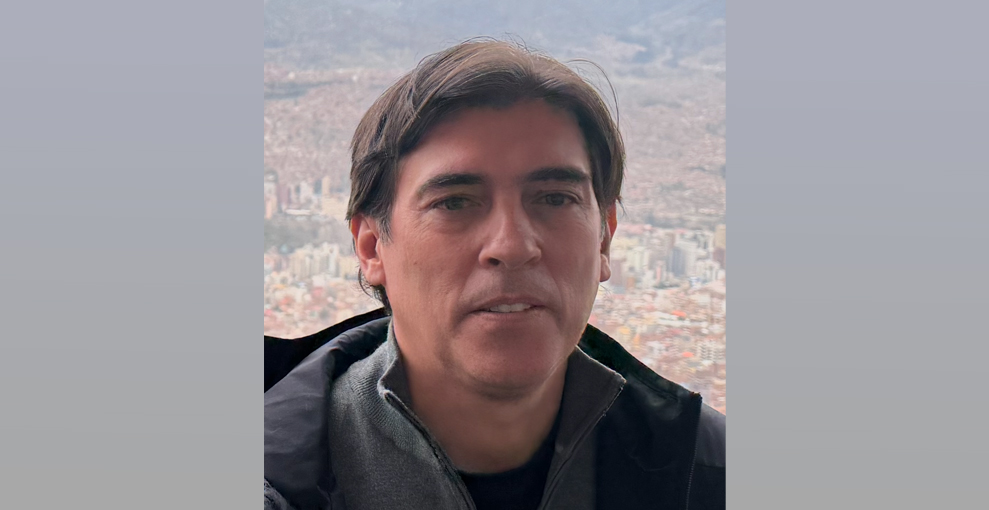
12 Sep Interview with Mauricio Zamora Liebers, Minister of Public Works, Bolivia
Can you please introduce your ministry and how you are working under the new government to transform Bolivia?
We are here on the cable car going up to El Alto. Our slogan is “we do things differently,” because here there has been a change after 20 years of administration. We are beginning a new stage under the leadership of President Rodrigo Paz, who says that this is collective leadership.
There is a new president, a new government, new governors and new mayors and now we have to work to rebuild the nation. What the president has brought is legal certainty and that is good for all countries outside Bolivia that previously did not invest because they were afraid. Now, the figure of Rodrigo Paz has provided legal certainty.
In the Ministry of Public Works, we are giving the ministry a new vision, because previously public works was something very cold; it was just the construction work and nothing more. Now we have a forward-looking vision centered on modernity and connectivity. The Ministry of Public Works is the largest ministry. To give you examples, I oversee BoA, which is Bolivia’s national airline; I oversee the airports and also the DGAC, which is the entity that grants all civil aviation permits. In addition, I also oversee the cable car system. We oversee the entire road sector of the country through the ABC, which is the entity responsible for bidding and overseeing all road-related matters. We also have another unit, AE Vivienda, which manages social housing and is also under the ministry. I also oversee other entities, such as the Airport Technical Unit, which handles the construction of all airports. I oversee the Railway Technical Unit, which manages the entire railway system and we are also somewhat involved in the waterway sector.
What is the vision behind all these entities? To truly achieve what our president says: “Bolivia to the world and the world to Bolivia” and to create connectivity that links us to the world. But that connectivity is not just about building a road, nor is it about having roads where things were done poorly due to bad planning. A road is useless if it is not maintained and that is the major problem we have. We already have a road infrastructure crisis precisely because proper maintenance was not carried out.
In addition to that, what we are seeking is Pacific-Atlantic connectivity and for Bolivia to become the center; not just a transit point with five bordering countries, but also a country from which products are exported outward. For example, in 20 years the country has failed to connect the two railway networks we have: the eastern and western systems. We are now planning the integration of both networks and with that we will be able to connect the two railway systems and transport all Brazilian cargo toward the Pacific.
In the road sector, we are also working on major projects so that, through the road network, we can create this connection. And in the aviation sector we have major airport projects, but the largest and most ambitious project is the Viru Viru hub. The idea is to grant the airport under concession to a company that can invest resources, become a partner of the Bolivian State and at the same time have operational experience. I have been to Lima and Rio de Janeiro and I witnessed how the Rio de Janeiro airport concession was awarded. With the Viru Viru hub, we are going to do the same thing. We are going to grant the airport under concession, for 25 or 30 years, to a company. We expect an investment of between $250 million and $500 million. That is not closed; it is open for companies interested in investing to come and present their proposals.
How will your government address concerns of investment predictability and regulatory clarity which has worried foreign investors before?
Considering the issue of legal certainty for investing in Bolivia, you can see that the ministry has many opportunities to attract investment. At the Viru Viru hub, we are also implementing changes to the toll system. I oversee the country’s toll system and the major problem is that it is still done the old-fashioned way, with paper tickets. Therefore, we are looking for a company that can bring technology similar to what exists in the United States, Europe and other countries, where there are electronic toll gantries and paper tickets are no longer necessary.
In the road sector, we are also working on a law that will form part of the Investment Law, because beyond the legal certainty provided by the president, an Investment Law will also be enacted. We are also working on the PPP Law. This is very interesting for investors, in the sense that we will say: ‘we do not have the money to build the road. Let a Spanish, American, or any other company come, build the road and then collect and operate the tolls for 20 years.’ At that point, there are already companies that may indeed be interested. It is a win-win situation, because what we want is development for Bolivia and the company that comes wants to generate economic returns.
So, there are companies that can build roads; there are companies that can participate in the Viru Viru hub project; there are companies that could potentially submit a proposal for BoA, because BoA may need a partner. Imagine this: when we began this administration, it had eight aircraft. Now, in less than five or six months, we already have 14 aircraft and we are going to reach 18 aircraft. Why? Because of a reactivation plan that we implemented.
Now we are in a second phase, which is more financial in nature, aimed at obtaining resources to allow BoA to grow. And this goes hand in hand with the vision I mentioned of not carrying out isolated projects. The BoA project goes hand in hand with Viru Viru, but also with a policy promoted by our president, who gave me the mandate and which I am implementing: opening our skies.
Sorry, the comment form is closed at this time.